

Anatomy of an Artist
Anatomy of an artist
Published with permission of The Waiheke Weekender
From driving cars through the desert to finding success as a professional artist on the other side of the world, Olivier Duhamel has found inventive ways to develop his art.
Olivier Duhamel was a late starter in finding a professional life as an artist, one in which he could earn a living from his talent. It took a series of circuitous events to bring the cheery Frenchman to where he is today, as an established sculptor and artist living on Waiheke, in the thick of the local art community even as he exhibits all over the world.
“I was drawing and painting from when I was very young, and I was encouraged to go to fine arts school. But it wasn’t for me. I wanted instant gratification and just didn’t have the patience for that sort of learning at that time in my life.”
As a child he loved to draw and was captivated by art, but he didn’t see his creative talents as a foundation for his future. To this little French boy, the art world of Paris and Europe seemed a place of snobbery and pretension, and not somewhere that he could ever belong.
He parked his creative aspirations and found work in Paris driving courier vans. Then he came across the opportunity for a much more exotic way to make money while feeding a young guy’s yen for a bit of adventure. He teamed up with others who were buying second-hand cars like Peugeots and Mercedes in France and driving them to faraway places like Nigeria and Cameroon where they would be used as taxis.
The journey of thousands of kilometres would take weeks, and involve driving over the Sahara desert, a place where the under-prepared or unlucky could easily come badly unstuck. The route was no paved highway, there were frequent sandstorms and the heat could be life-threatening. It was remote, it was vast and there was the possibility of bandits.
Olivier grins when he looks back on it all.
“We’d travel in groups. But you couldn’t help reading that sign as we set off into the Sahara. It said: ‘Beyond here you are on your own.’ But Olivier did make those trips unscathed, and later moved on to work building swimming pools in the south of France.
Once he met his wife-to-be, Marie-France, he set his sights on a different adventure in the southern hemisphere and almost accidentally took up a career that would later equip him with invaluable skills in his artistic practice. The couple left France in 1984 and went to Australia and to Tahiti, where they found work easily.
“We both worked as computer programmers. Back then you could get a job as a programmer without experience. You just had to work it out as you went.”
It turned out Olivier had a bent for computer technology. The couple were keen to settle in Australia but immigration rules were making that difficult and an offer of work in New Zealand, along with an easier path to residency, made the choice for them. They arrived, fell in love with the place and have been here ever since.
On the day he arrived, Olivier decided he would check out his one and only contact here, a woman who lived on Waiheke.
“I came over here on the old ferry, the Baroona. I went all over the island on a bike that day and I loved the place from that first visit.”
Beautiful Waiheke had worked its magic on him but it wasn’t going to become home for some time, as there was a living to be earned in the city in the world of computers.
Olivier and Marie-France were raising three children: Nina, Tim and Margo, so Olivier’s inner artist was yet to meet the world.
“When you have a young family, you have to focus on making a living, raising them,” he says.
“My life has been divided into youthful adventure, raising my family and earning a living, and now my life here, living and working in my studio on Waiheke.”
When changes came in his working life in computers, and his children were well grown, it was Marie-France who gave him the push he needed to change direction. She had studied to gain her doctorate in linguistics and for years has travelled offshore for work in her field.
“Marie-France said to me ‘you have always loved art. Why don’t you try that now?’
And I thought, well, why not?”
He started making little bronzes in the early 2000s, enrolling in a bronze casting workshop, beginning a journey to the mastery of that craft that he’s now known for.
With a few others, Olivier pulled together a little foundry. His first exhibition at the Waiheke Community Art Gallery in 2004 promised an exciting public debut, but in fact none of his bronze nudes sold. Undeterred Olivier tried his luck at a gallery in the city. (The Parnell Gallery) Lift off for the career that followed was almost instant.
“Within a couple of days the gallery called and told me they’d sold the little bronze female torso I’d taken in. They wanted more of them.”
Olivier worked long and hard to keep turning out those beautiful bronze figures, and as fast as he could make them, they were in demand from other galleries and the buyers who frequented them. They kept on selling, making his name and establishing a market for him across the country. He found he was in business.
“That one small bronze launched me just like that. Success in that first gallery gave me street credibility with all the other galleries and they wanted my work.”
The first popular bronze that turned heads, and set galleries calling, was of the female figure and it is the female form that dominates his work.
His explanation for that might surprise. Olivier says it is the form he chooses to depict most often because he loves contemporary dance and he has been wanting to capture the beauty and emotion of dancers in his sculpture. Somehow, in the unyielding materials he uses, bronze, wood, acrylics, the softness, flow, delicacy and curves all emerge under his expert hand.
Olivier works at home, not far from Oneroa village. He takes time out to make a cup of tea in the kitchen of his near original, very woody 1970s home to talk about life as an artist and making a living. His daughter Nina is visiting with his little grandson, and they disappear outside into the restful shady garden where some of his larger works are artfully placed. It is a charming scene.
Just over two decades on from that first Waiheke exhibition, Olivier has sold hundreds of pieces and until Covid closed the world down, altering the flow of the marketplace, most of his work was sold overseas to customers and galleries in the United States, Europe, Asia and Australia. He has been a prolific producer and a very regular exhibitor with his award-winning works in many collections here and overseas. His exhibitions, both here and offshore, now number 120 since his beginnings in 2007.
From just a peak at his social media before the lockdown years, you can see a steady flow abroad of named pieces from his island studio. An iteration of Rosie, a favourite bronze, has gone to Miami, Roxie’s torso went to Washington, Aarwyn went to San Diego. A torso of Bruce went to France, and Myriam and another Rosie were sent to France too, as was little bronze Christine. A wooden Ariane went to an exhibition in Kansas. These exquisite Duhamel women, in all their shapes and sizes, certainly were taking their places out there in the international art world.
Much closer to home and outside the galleries he is associated with, his works have featured in Auckland’s big outdoor sculpture events and exhibitions.
In that same year, 2018, Playboy magazine featured his work, noting: “Olivier Duhamel sculpts nudes for 21st century eyes only.” His personal statement about his work and his intentions in making it reflect his dislike of what he sees as pretension.
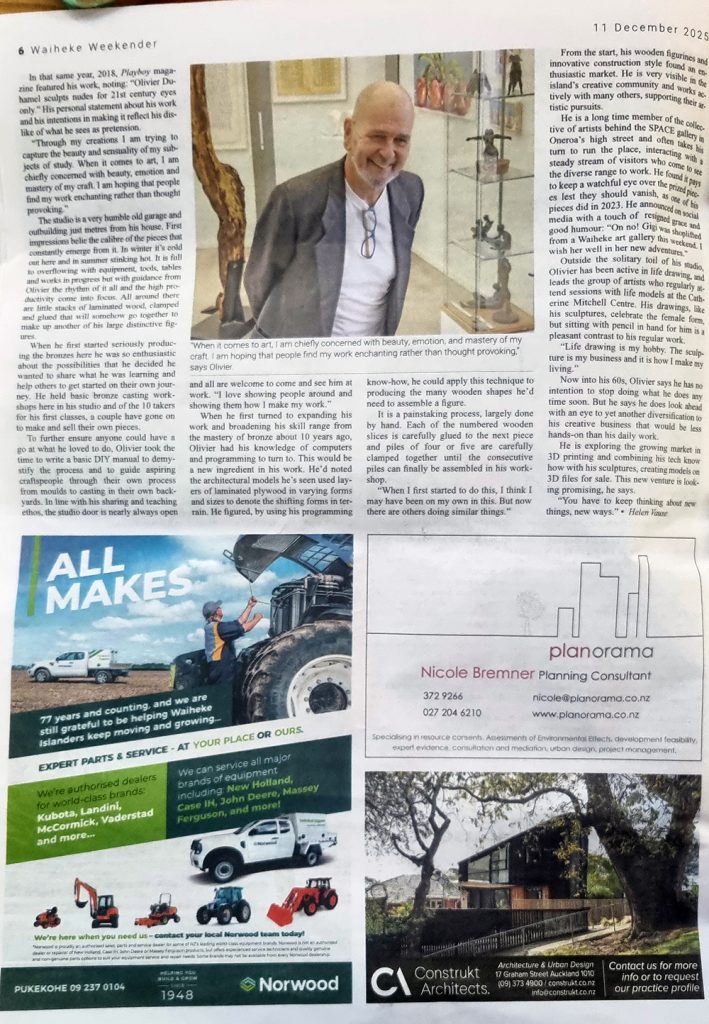
“Through my creations I am trying to capture the beauty and sensuality of my subjects of study. When it comes to art, I am chiefly concerned with beauty, emotion and mastery of my craft. I am hoping that people find my work enchanting rather than thought provoking.”
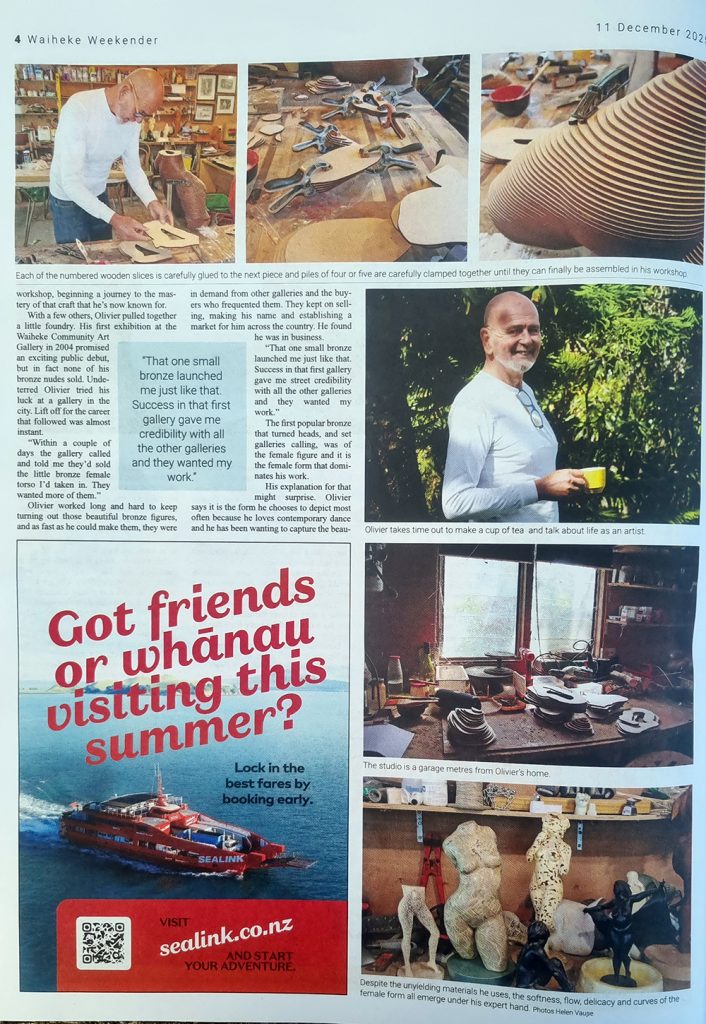
The studio is a very humble old garage and outbuilding just metres from his house. First impressions belie the calibre of the pieces that constantly emerge from it. In winter it’s cold out here and in summer stinking hot. It is full to overflowing with equipment, tools, tables and works in progress but with guidance from Olivier the rhythm of it all and the high productivity come into focus. All around there are little stacks of laminated wood, clamped and glued that will somehow go together to make up another of his large distinctive figures.
When he first started seriously producing the bronzes here he was so enthusiastic about the possibilities that he decided he wanted to share what he was learning and help others to get started on their own journey. He held basic bronze casting workshops here in his studio and of the 10 takers for his first classes, a couple have gone on to make and sell their own pieces.
To further ensure anyone could have a go at what he loved to do, Olivier took the time to write a basic DIY manual to demystify the process and to guide aspiring craftspeople through their own process from moulds to casting in their own backyards. In line with his sharing and teaching ethos, the studio door is nearly always open and all are welcome to come and see him at work. “I love showing people around and showing them how I make my work.”
When he first turned to expanding his work and broadening his skill range from the mastery of bronze about 10 years ago, Olivier had his knowledge of computers and programming to turn to. This would be a new ingredient in his work. He’d noted the architectural models he’s seen used layers of laminated plywood in varying forms and sizes to denote the shifting forms in terrain. He figured, by using his programming know-how, he could apply this technique to producing the many wooden shapes he’d need to assemble a figure.
It is a painstaking process, largely done by hand. Each of the numbered wooden slices is carefully glued to the next piece and piles of four or five are carefully clamped together until the consecutive piles can finally be assembled in his workshop.
“When I first started to do this, I think I may have been on my own in this. But now there are others doing similar things.”
From the start, his wooden figurines and innovative construction style found an enthusiastic market. He is very visible in the island’s creative community and works actively with many others, supporting their artistic pursuits.
He is a long-time member of the collective of artists behind the [ s p a c e ] gallery in Oneroa’s high street and often takes his turn to run the place, interacting with a steady stream of visitors who come to see the diverse range of work. He found it pays to keep a watchful eye over the prized pieces lest they should vanish, as one of his pieces did in 2023. He announced on social media with a touch of resigned grace and good humour: “Oh no! Gigi was shoplifted from a Waiheke art gallery this weekend. I wish her well in her new adventures.”
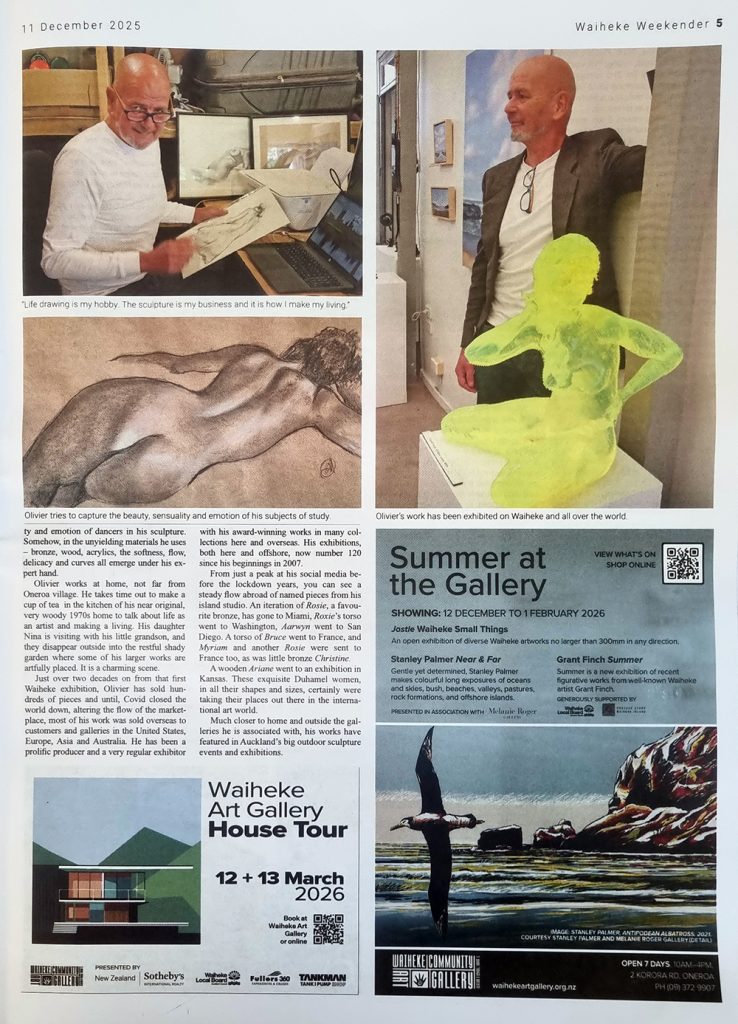
Outside the solitary toil of his studio, Olivier has been active in life drawing, and leads the group of artists who regularly attend sessions with life models at the Catherine Mitchell Centre. His drawings, like his sculptures, celebrate the female form, but sitting with pencil in hand for him is a pleasant contrast to his regular work.
“Life drawing is my hobby. The sculpture is my business and is how I make my living.”
Now into his 60s, (68) Olivier says he has no intention of stopping doing what he does any time soon. But he says he does look ahead with an eye to yet another diversification to his creative business that would be less hands-on than his daily work.
He is exploring the growing market in 3D printing and combining his tech know-how with his sculptures, creating models and 3D files for sale. This new venture is looking promising, he says.
“You have to keep thinking about new things, new ways.”
